Ask most Indian homeowners about rainwater harvesting and they will call it a good habit — something you do to recharge a borewell or tick a municipal box. On one tiny island in the Nicobar group, rainwater is something else: it is the water supply, full stop. A recently documented government project there makes a point every mainland household deserves to hear — rain, collected and stored deliberately, can be the cheapest reliable water a home will ever have, because the catchment is a roof you already own.
An island with no freshwater — and what ICAR did about it
Chowra Island sits in the Andaman Sea between Teressa and Battimalv islands, in the Nancowry Division of the Nicobar district — one of India’s most remote inhabited islands. Its isolation has preserved a distinct way of life but made water security a constant struggle. Chowra has no dependable freshwater source: its hydrogeology leaves most shallow groundwater saline and unfit for drinking or irrigation, so residents depend almost entirely on rainfall for domestic, agricultural and livestock needs. Households have long harvested rooftop rainwater into plastic or steel tanks, but that storage runs short in the dry season, and building anything larger was hard given the cost of shipping machinery and materials to so remote a place.
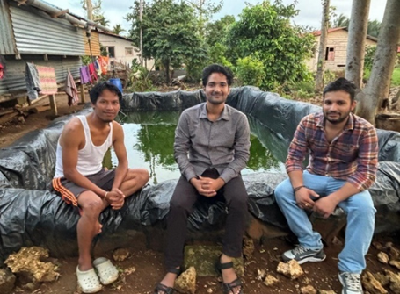
The response came from ICAR–Krishi Vigyan Kendra (KVK), CIARI, Nicobar, working with the Tribal Council of Chowra. Together they built ten rainwater harvesting ponds, each 7 m × 5 m × 1.5 m, lined with HDPE sheets to stop seepage. Because heavy earthmoving equipment could not be landed, and because hard coral rock lies beneath the soil, the ponds were excavated by hand with portable drilling machines. The stored water improved freshwater availability for irrigation and livestock, and became an important source for domestic use too. To keep it clean, the ponds were fenced and covered against contamination.
A note for the record: Rainable India / RPV Enterprises had no involvement whatsoever in the Chowra Island project. The work is entirely that of ICAR-KVK CIARI, Nicobar, and the Tribal Council of Chowra. We cite it purely as a public-interest illustration of what deliberate rainwater harvesting can achieve. Nothing here implies that ICAR endorses Rainable or any commercial product.
Why the Chowra model worked: it was economical
The most striking thing about the Chowra project is not its ambition but its restraint. The design was simple, the cost low, and it leaned on local labour rather than imported machinery — which is precisely why it worked where almost nothing about infrastructure is easy. The community welcomed it for its “affordability, practicality, and ease of replication,” and the response proved the point: several farmers offered to build their own ponds, and the Tribal Council formally asked ICAR-KVK CIARI for continued guidance and HDPE lining support to replicate the model island-wide.
That lesson travels far beyond the Nicobar Sea. A water solution scales when it is cheap enough to copy without a subsidy, simple enough to maintain without specialists, and independent enough to run without a supply chain you cannot control. Chowra did not solve its water problem by spending more; it did so by treating rain as the primary resource and building for it economically.
The half of the problem that filtration solves
Mainland India is not Chowra, but look past the geography and the problem is familiar. Across the country, crores of households live with saline or hard groundwater, unreliable piped supply, and a recurring bill for water cans and tankers. The form differs; the shortage is the same. And so is the answer Chowra points to — collect the rain that falls on your own roof.
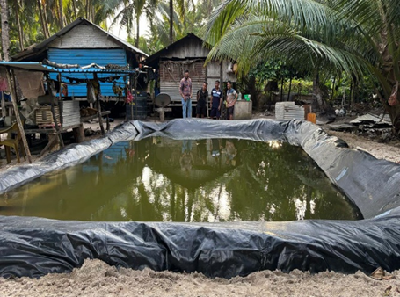
It is worth being honest about what the ICAR project did and did not do. It solved the storage half economically. What it did not leave to chance was water quality — notice the ponds had to be fenced and covered specifically to keep the stored water clean. That is exactly the challenge a rooftop household faces: a roof collects dust, leaves, bird droppings and the grimy first wash of a dry spell along with the water, and storing that untreated means storing the contamination too. Quality has to be handled at the point of collection, before the water reaches the tank. That is what a rooftop rainwater filter does, and where Rainable comes in.
Rainable: the same economics, applied to water quality
Rainable takes the principle ICAR proved on Chowra — low cost, no external dependencies, easy to replicate — and applies it to filtration, so rooftop rainwater becomes a viable drinking and cooking source anywhere in India. The Rainable Midi-150 is a rooftop rainwater filter built for a home-scale roof. Designed in Germany and made in India, it works with no power, no pressure and no chemicals.
Its filtration is purely mechanical — an adhesion-and-cohesion principle across a food-grade SS316 stainless steel element — so there is nothing to dose or replace. Two features work automatically: an automatic first flush diverts the dirty initial rainfall away from storage with no valve to operate, and automatic self-cleaning carries debris out continuously, so it does not clog and needs no seasonal cleaning. The filter also aerates the water, enriching it with oxygen to keep stored water fresh and resist stagnation.
| Specification | Detail |
|---|---|
| Suitable roof area | Up to 150 m² |
| Max rainfall intensity | 100 mm / hour |
| Filter capacity | 3.4 litres / second |
| Filter type | Vertical model, flush type |
| Working principle | Adhesive & cohesive |
| Filter element | SS316 food-grade stainless steel |
| Filter housing | UV-treated poly |
| Mesh size | 280 microns |
| Inlet / clean outlet / 2nd category outlet | 100 mm / 75 mm / 100 mm |
| Filter efficiency | Above 95% |
| Operating pressure | None required |
| Power | None required |
| Warranty | 10 years |
It is modular and scalable, so the same approach fits homes, apartment associations, schools, hospitals and factories — you size the filter to the roof rather than rebuilding the idea.
What it costs to run: nothing
The economics are the whole argument. Once a Rainable filter is installed, the running cost is essentially zero:
- Zero electricity — no power and no pump; gravity and rainfall do the work.
- Zero consumables for a lifetime — no cartridges, membranes or chemicals to replace.
- Zero seasonal cleaning labour — automatic self-cleaning means no annual strip-down.
- Zero operating pressure — no dependence on line pressure or a booster pump.
- A catchment you already own — your roof is the collection surface, so there is no land or borewell to pay for.
- A 10-year warranty on the filter itself.
Set that against the recurring cost of cans and tankers and the comparison is stark. As a rough guide, harvestable litres can be estimated as roof area (m²) × annual rainfall (mm) × 0.8 — so a 150 m² roof in a place receiving about 1,000 mm a year could yield roughly 1,20,000 litres annually. That is an estimate, not a guarantee, but the point stands: the raw material is free and lands on your terrace every monsoon.
Drinking and cooking, done properly
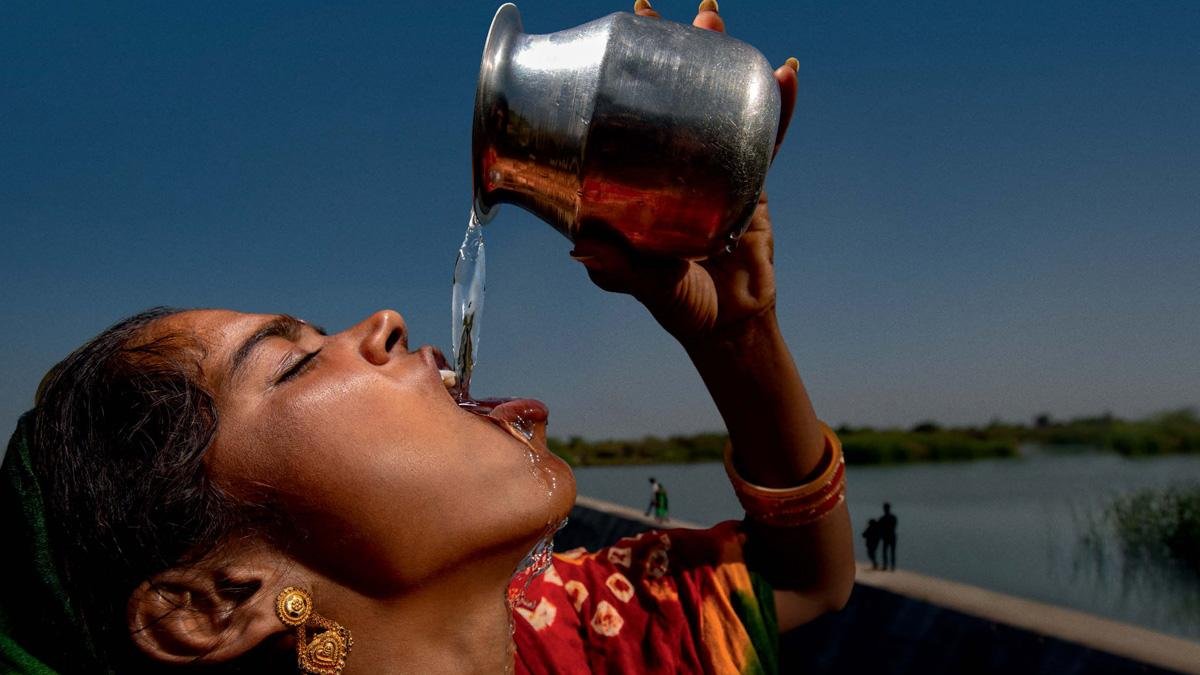
Being straight about potability matters. Rainable delivers mechanically filtered, oxygen-enriched, chemical-free rainwater that is potable-ready. For drinking and cooking, we recommend storing it in a covered, opaque tank and adding one simple final disinfection step — a UV lamp or plain boiling. Because Rainable has already removed the solids, that final stage stays cheap and low-maintenance: you are disinfecting clean, aerated water, not fighting through sediment first. It is the same logic the Chowra ponds followed when they were fenced and covered.
From Nicobar to the mainland: this works everywhere in India
Rooftop harvesting adapts to wherever you live. Broadly, three situations cover most of the country.
High-rainfall coasts and hills — the Konkan and Kerala coast, coastal Karnataka, the Western Ghats and the Northeast. Rain is abundant but seasonal, and much of it simply runs off. A filter plus adequate storage turns that runoff into months of clean household water, with generous yields from even a modest roof.
Monsoon plains — the Gangetic belt and much of central India, where most of the year’s rain arrives in a few intense months. The challenge is timing, not quantity, which makes clean capture and covered storage during the monsoon the difference between water security and dependence on erratic supply the rest of the year.
Hard-water and saline belts — parts of Rajasthan, Gujarat, Telangana, coastal Tamil Nadu and other pockets where groundwater is brackish or heavily mineralised. This is the closest mainland echo of Chowra: the ground simply does not give good water, and rooftop rainwater is the soft, low-salinity alternative already falling from the sky. Rainable makes it clean enough to drink.
None of this asks a household to spend more. It asks them to do what Chowra did — treat rain as the primary source, and build for it economically.
Talk to us
If you want to work out what rooftop rainwater harvesting could do for your home, apartment block or institution, get in touch. Call +91 99449 12302, email info@rainable.in, or reach us through our contact page. Explore the Rainable Midi-150 to see the specifications in full.
Frequently asked questions
Is rooftop rainwater really cheaper than tankers and water cans?
Yes. The catchment is a roof you already own, and a Rainable filter runs with zero electricity, zero consumables and no recurring cost. Once installed, your main ongoing outlay is a simple final disinfection step for drinking water. Compared with buying cans or booking tankers month after month, rooftop rainwater is among the most economical reliable water a household can get.
Can I drink and cook with Rainable-filtered rainwater?
Rainable delivers mechanically filtered, oxygen-enriched, chemical-free rainwater that is potable-ready. For drinking and cooking, store it in a covered, opaque tank and add one simple final disinfection step — a UV lamp or boiling. Because Rainable has already removed the solids, that final stage stays cheap and low-maintenance.
How much water can my roof collect?
As an estimate, harvestable litres = roof area (m²) × annual rainfall (mm) × 0.8. For example, a 150 m² roof in an area receiving about 1,000 mm of rain a year could yield roughly 1,20,000 litres in a year. Your actual figure depends on your roof size and local rainfall.
Does the Midi-150 need electricity or regular maintenance?
No. The Midi-150 needs no power and no operating pressure. Its automatic first flush diverts the dirty initial rainfall, and automatic self-cleaning carries debris out continuously, so it does not clog and needs no seasonal cleaning labour. It has no consumables to replace and carries a 10-year warranty.