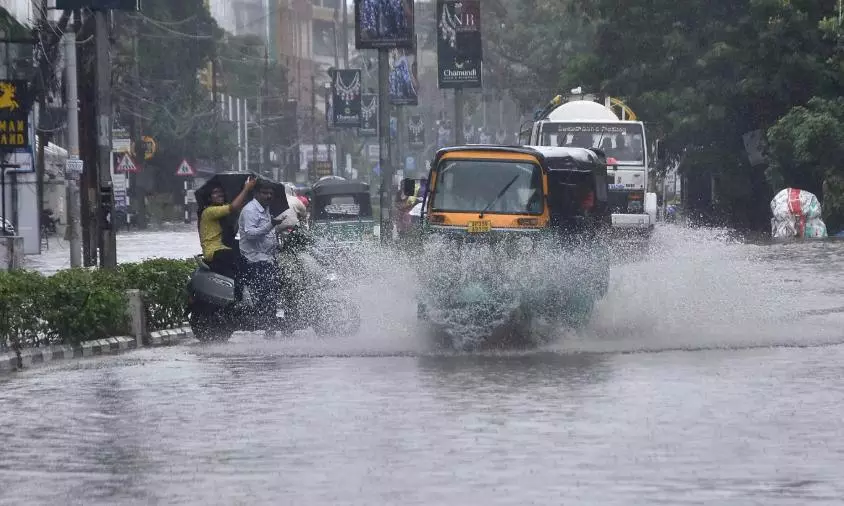
Rainwater harvesting for schools matters most on days like 16 October. That day, News18 Tamil Nadu reported water standing inside a government school campus at Sakkampatti, near Andipatti in Theni district, after heavy rain. The report’s description points to a drainage problem. So how can a school turn that water from a nuisance into a resource?

Why do school campuses flood in the northeast monsoon?
The India Meteorological Department (IMD) expected the northeast monsoon to begin over south India on 15 October. It forecast fairly widespread to widespread rain over Tamil Nadu from 15 to 20 October, with isolated very heavy falls on 15 October. IMD classes 64.5 to 115.5 mm of rain as heavy.
Campuses can flood for simple reasons. Paved yards shed water fast, silt and plastic block drains, and low corners trap runoff. As a result, the rain has nowhere to go.
This year also carries a warning on the other side. The southwest monsoon ended 12.6% below normal, at 759.4 mm against 868.6 mm, as El Niño strengthened. So a campus that floods now may still run short of water later. We explain this double risk in our post on rainwater harvesting in India.
What does rainwater harvesting for schools involve?
Rainwater harvesting for schools has three simple steps:
- Collect. Roof downpipes carry rain to one point instead of the yard.
- Filter. A filter removes leaves, dust and bird droppings, and it discards the dirtiest water first.
- Store or recharge. Clean water goes to a tank for toilets and gardens, or into a recharge pit or well that feeds the groundwater.
Moreover, the first and third steps take pressure off the drains, so less water runs across the yard.
How much water does a school roof shed in one heavy spell?
The maths behind rainwater harvesting for schools is simple. One millimetre of rain on one square metre of roof gives one litre of water.
Water collected (litres) = roof area (m²) × rainfall (mm) × runoff coefficient
For illustration, take a 1,000 m² school roof, one heavy spell of 100 mm and a runoff coefficient of 0.8. That gives about 80,000 litres. In other words, it is enough to fill eight tanks of 10,000 litres each. However, your own number will depend on your roof type and on the rain your area receives.
Can rainwater harvesting for schools recharge groundwater?
Yes, and it need not cost much. The Centre for Science and Environment (CSE) describes a Delhi school, Mira Model School, that built a recharge system in June 2001 for Rs 1.20 lakh. Its roofs and grounds cover 16,200 sq m. Runoff passes through a desilting chamber and a pebble-and-sand filter into recharge wells, so the campus needs no storage tanks. The case study puts the harvested volume at about 4,454 cubic metres, roughly 45% of the site’s potential.
Design details matter, so ask a qualified engineer to size pits and wells for your soil and rainfall. You can also read more about ground recharge with Rainable filters.
What do Tamil Nadu rules say about rainwater harvesting for schools?
Tamil Nadu amended Section 215(a) of the Tamil Nadu District Municipalities Act, 1920, and the Building Rules, 1973. These changes make rainwater harvesting structures mandatory in all new buildings. The state also reports that 23,190 of 24,116 government buildings in town panchayats already have such structures, leaving 926 without. However, its page does not list school buildings separately, so confirm the details with your local body.
Why filters matter for school rainwater harvesting
A school roof collects dust, leaves and droppings. Without a filter, all of that reaches your pit or tank. A good filter should do four things:
- Discard the dirtiest water automatically with a first-flush function.
- Clean itself as water flows, so debris never clogs the mesh.
- Work without power or consumables, even during storms and power cuts.
- Keep stored water fresher with gentle inlets and oxygen enrichment.
Rainable designed the Midi-150 filter for roofs up to 150 m². Its modular design lets you scale up, so a large school roof needs several units across its downpipes. It also uses a 280-micron SS316 mesh, handles 3.4 litres per second and reaches more than 95% efficiency. Finally, it needs no power or consumables, and it carries a 10-year warranty.
Note on drinking water: filtered rainwater becomes potable-ready only after a final disinfection step. Schools can start with toilets, gardens, cleaning and recharge.
A rainwater harvesting for schools checklist
Use this list before and during the monsoon, so your campus stays ready:
- Walk the campus in the rain and note where water stands.
- Clear drains of silt and plastic before each monsoon.
- Connect every downpipe to a filter, then to a pit or tank.
- Place recharge pits where runoff collects, as your engineer advises.
- Keep toilet and sewage lines away from recharge pits.
- Inspect the filters and pits after each heavy spell.
Frequently asked questions
Will rainwater harvesting stop my school campus from flooding?
It can reduce runoff, but it does not replace good drains. Therefore, do both: fix the drainage, and send roof water to a filter and a pit.
Is rainwater harvesting mandatory for school buildings in Tamil Nadu?
The state requires it in all new buildings. However, confirm the details for your school with your municipality or panchayat.
Can students drink harvested rainwater?
Only after proper filtration and a final disinfection step. Meanwhile, schools can use the water for toilets, gardens and cleaning.
Plan rainwater harvesting for schools with Rainable
The northeast monsoon has only just started, so there is still time to act. Whether you run a school, a trust or a panchayat, the Rainable team can help you size filters for your roof. Call +91 9944912302, message us on WhatsApp, or visit our contact page. You can also browse more guides in our articles section, and see how rules are tightening in rainwater harvesting in Delhi.
Get a free rainwater consultation
Sources