Rainwater harvesting in Coimbatore is back in focus. The Hindu reports that the Corporation has surveyed 1,43,606 buildings across its five zones to assess their rainwater harvesting facilities. So an important question follows: if an officer visited your building tomorrow, would it be ready?
What does the Coimbatore survey mean for building owners?
According to the Corporation, the survey covers residential buildings, government buildings and commercial establishments. Staff worked ward by ward across all 100 wards. Meanwhile, the survey ran for a week up to 13 October. The Corporation is also holding awareness programmes in its own and government schools, with speech, drawing, singing and slogan competitions.
Importantly, building owners have been told to maintain any rainwater harvesting structure that is not properly maintained. So a pit or filter that exists but is blocked or neglected does not help you. In the meantime, you can check your own building in about an hour.
What does Tamil Nadu law say about rainwater harvesting?
Tamil Nadu amended Section 215(a) of the Tamil Nadu District Municipalities Act, 1920, and the Building Rules, 1973. These changes make rainwater harvesting structures mandatory in all new buildings. The state also monitors the provision when it approves building plans. However, the state’s page does not say how the rule applies to older buildings. So ask the Corporation if your building pre-dates it.
Why does rainwater harvesting in Coimbatore matter?
Coimbatore knows both sides of the problem. In 2003, the city received 65% less rainfall than in earlier years, according to Siruthuli, and its groundwater table fell. Siruthuli then worked with the Corporation on recharge structures across the city. Then a 2018 report counted more than 600 of them. Because Coimbatore sits on hard rock, the group also drilled recharge borewells to push water into the aquifer.
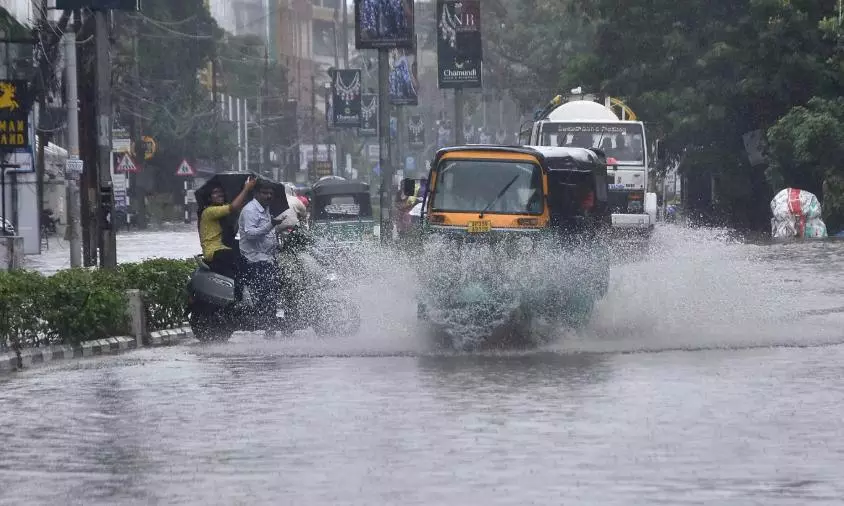
The other side is flooding. In November 2025, the Corporation prepared a Rs 2,200-crore plan to upgrade stormwater drains across all 100 wards. The plan aims to end monsoon waterlogging, since rain often runs along roads instead of into drains. Therefore, every roof that keeps its rain on the plot takes a little pressure off the street.
Ahead of the northeast monsoon, the Corporation has also been desilting stormwater drains and canals. It has allocated ₹50 lakh to each of the five zones for desilting. Another ₹50 lakh per zone is set aside for road repairs. Desilting covers 120.44 km of drains, of which 58.46 km is complete. In the Central Zone, this includes the 3.195-km Rajavaikkal in Ward 62, at a cost of ₹25 lakh.
Moreover, this year adds a third reason. The southwest monsoon ended below normal as El Niño strengthened. We explain what that means in our post on rainwater harvesting in India.
Is your building ready? A simple check
Because the Corporation is checking, walk your property during the next rain and ask these questions:
- Does every downpipe lead to a filter, a pit, a well or a tank?
- Is there a recharge pit or borewell, and is it clear of silt and waste?
- Does the system have a filter and a first-flush function?
- Can you find your approved plan and any photos of the structure?
- Are sewage and toilet lines kept away from the recharge pit?
If you answer “no” to any of these, fix it as soon as you can. Moreover, a working system also saves you water.
How much rain can your roof collect?
The maths behind rainwater harvesting in Coimbatore is simple. One millimetre of rain on one square metre of roof gives one litre of water.
Water collected (litres) = roof area (m²) × rainfall (mm) × runoff coefficient
For illustration, take a 150 m² roof, one heavy spell of 100 mm and a runoff coefficient of 0.8. That gives about 12,000 litres from a single spell. However, your own number will depend on your roof type and on the rain your area receives.
Why filters matter for rainwater harvesting in Coimbatore
Roofs collect dust, leaves and bird droppings. Without a filter, all of that reaches your pit, tank or borewell. This matters most for recharge borewells, because they connect directly to the aquifer. A good filter should do four things:
- Discard the dirtiest water automatically with a first-flush function.
- Clean itself as water flows, so debris never clogs the mesh.
- Work without power or consumables, even during storms and power cuts.
- Keep stored water fresher with gentle inlets and oxygen enrichment.
Rainable designed the Midi-150 filter for roofs up to 150 m². It also uses a 280-micron SS316 mesh, handles 3.4 litres per second and reaches more than 95% efficiency. Finally, it needs no power or consumables, and it carries a 10-year warranty. You can read more about ground recharge with Rainable filters.
Note on drinking water: filtered rainwater becomes potable-ready only after a final disinfection step. Never drink it raw from the tank.
Frequently asked questions
Is rainwater harvesting in Coimbatore mandatory for my building?
Tamil Nadu requires it in all new buildings. For an older building, confirm the position with Coimbatore Corporation.
My building has an old pit that no longer drains. What should I do?
Have a qualified engineer inspect it. Often, cleaning the pit and adding a filter at the downpipe restores it.
Can I drink harvested rainwater?
Only after proper filtration and a final disinfection step. Meanwhile, you can use it for gardens, cleaning and toilets.
Get ready for rainwater harvesting in Coimbatore with Rainable
The northeast monsoon has started, but there is still time to act. Whether you own a home, a school or an apartment block, Rainable can help you size filters. Call +91 9944912302, message us on WhatsApp, or visit our contact page. You can also browse more guides in our articles section, including our post on rainwater harvesting for schools.
Get a free rainwater consultation
Sources
- The Hindu: Coimbatore Corporation surveys 1.43 lakh buildings for rainwater harvesting
- Government of Tamil Nadu: Rain Water Harvesting
- The News Minute: Coimbatore civic body unveils Rs 2,200 crore stormwater drain plan
- The Better India: How Siruthuli revived Coimbatore’s water table
- DT Next: North East monsoon to start with a bang on October 15